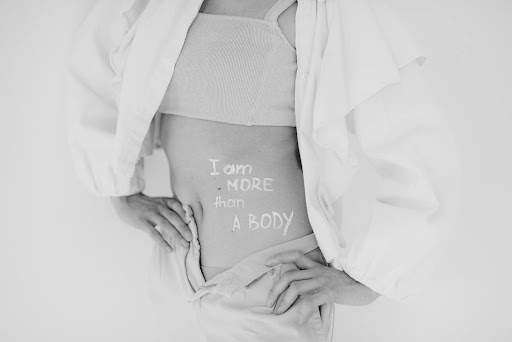




Have you ever caught your reflection and thought, ‘I hate my body’, instantly zooming in on the parts of yourself that you don’t like?
Maybe it’s your stomach, arms, skin, face. I know for me it was my nose, thighs and height! Your eyes go there before you’ve even had a chance to think.
It’s exhausting. Why is it so hard to just look at yourself without picking something apart? Your brain asks, ‘What is the matter with me?’ The anxiety, stress, guilt, shame, and sadness feel so heavy!
This isn’t vanity. It’s not self-obsession. And it doesn’t mean something is wrong with you.
For many people, this is part of living with body insecurity and body image anxiety. It’s a pattern your brain has learned over time, one where it views your body through a critical lens.
You are not broken and there 100% nothing wrong with you. I know you might not believe that right now, but your brain is doing exactly what it’s learned to do- stay safe and gather evidence that supports what it already believes. That’s why body image can feel so relentless. It’s not just what you see. It’s the meaning your brain has attached to it.
Your Brain Looks for Proof of What It Already Believes
One reason this happens is confirmation bias. In simple terms, your brain is wired to notice things that support what you already believe, and overlook what doesn’t.
We all do this in different areas of life. But when it comes to negative body image, body image patterns can feel especially heavy.
If there’s a belief sitting underneath everything, something like, “My body isn’t good enough”, your brain will quietly start gathering proof.
It notices the angle in a photo. The way your clothes sit that day. The comparison you didn’t even mean to make. Suddenly, it feels like evidence is everywhere.
So if you already believe, “My stomach is too big,” your brain will keep bringing your attention back to it. Not because it’s the most important thing about you, but because your mind has learned that it matters.
This is a core part of body image psychology. Your brain is constantly trying to make sense of things, to create patterns, to keep you safe in the ways it understands.
If it has learned that your appearance is tied to your worth, your acceptance, or your sense of belonging… of course, it’s going to stay alert to it.
That doesn’t make the pattern helpful. But it does make it human.
How Body Checking Becomes Automatic
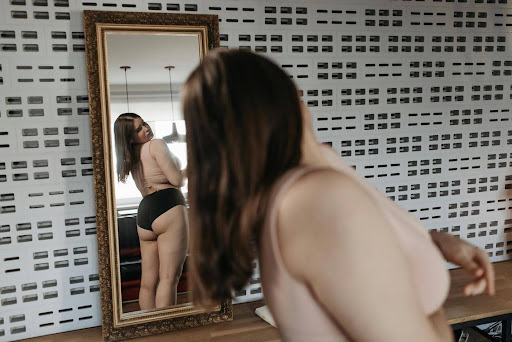
Over time, this can turn into something called body checking. And most of the time, you’re not even fully aware you’re doing it.
It might look like catching yourself in the mirror multiple times a day. Focusing on the same body part in every photo. Comparing yourself to someone else without even meaning to.
Sometimes it’s obvious. Other times, it’s so subtle it just feels like… part of how you exist.
That’s because body checking often becomes a habit your brain has learned, not a conscious decision you’re making.
Somewhere along the way, your brain linked “checking” with staying aware, staying prepared, maybe even staying safe. So it keeps doing it.
The problem is, it rarely reassures you. It fuels body image anxiety and reinforces negative body image instead.You check to feel better… and find something else. Or the same thing again. The same frustration. The cycle strengthens.
Why It Feels So Hard to Switch Off
This is the part that can feel the most frustrating. Once the pattern is there, it can feel almost impossible to turn off.
The more your brain notices something, the more important it starts to feel. And the more important it feels, the more your brain goes back to check.
You notice a “flaw” and without a second thought you feel discomfort, anxiety, or shame. You check again, hoping for reassurance. And instead… You reinforce the thought you just had!
That’s how body image and appearance anxiety become consuming. It’s not a passing thought. It’s a loop. And repetition makes it feel true.
Over time, it can begin to feel like your body is the problem. When really, it’s the pattern your brain has learned, the way it scans, interprets, and responds.
The Emotional Impact Goes Far Beyond the Mirror
Living like this is tiring in a way that’s hard to explain. It’s not just about how you feel when you get dressed or see a photo. It follows you into your day. Into conversations. Social situations. Moments that are supposed to feel light.
Part of your attention is always pulled back to your body image.
It can make you feel less present. More self-aware. Sometimes even disconnected from yourself, like you’re being watched, even when no one is watching.
This is one of the quieter sides of body image insecurity. That constant, low-level alertness. The tension you carry without realising it. Over time, it’s exhausting.
If you feel worn down by it, that makes sense. You’re not overreacting. You’re not being dramatic. You’ve just been carrying something heavy for a long time.
You Can Heal Your Relationship with your Body
As frustrating as this pattern is, it usually isn’t really about the body. More often, it’s about what the body has come to mean.
For many people, body image struggles are connected to deeper beliefs about worth, acceptance, and emotional safety. The focus on the body can become a way of trying to stay in control… or avoid feeling something more vulnerable underneath.
Your brain isn’t trying to sabotage you. It’s trying to protect you. It’s just using a strategy that no longer works. And that matters, because it changes how you respond to it.
Instead of meeting it with more frustration or shame, you can begin to meet it with understanding.
You can notice the pattern without immediately believing it. You can remind yourself that it was learned. And what was learned can be softened over time.
Healing body image anxiety isn’t about forcing yourself to love everything you see.
It’s about becoming more aware and curious of the patterns, and being more compassionate with yourself.
When you understand your body image patterns, something shifts.If this resonates with you, you can find support inside the Roadmap to Body Confidence and Self Love Book or Online Course version.

Hey I’m Natalie, Supporting women like you on their road to self-acceptance and building a positive body image.

View comments
+ Leave a comment